

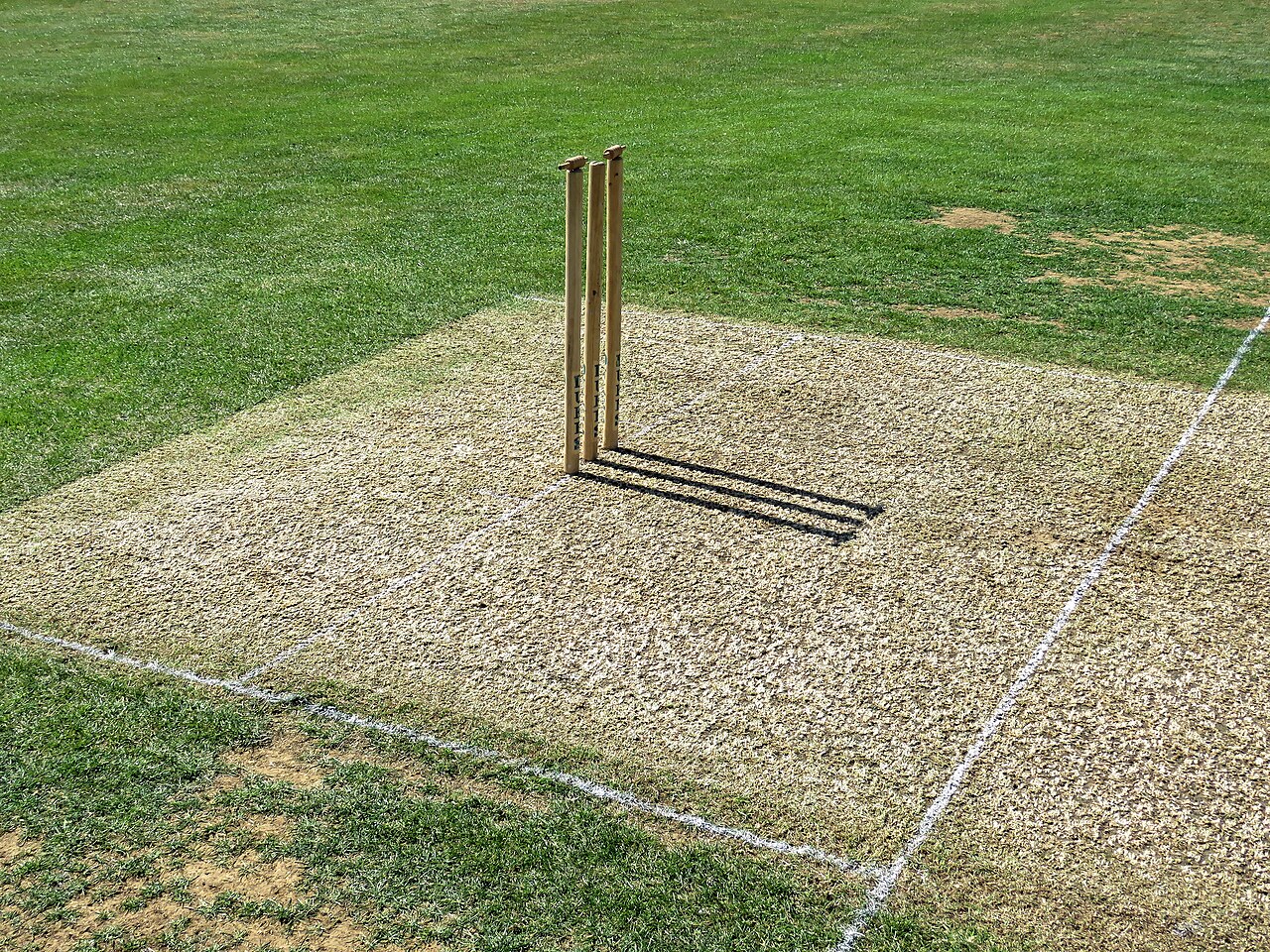
A season followed from a Bhavnagar rooftop
The best seat in Bhavnagar in the middle of January is the roof. Ours is flat, edged with a parapet low enough to be a genuinely bad idea, and by seven on Uttarayan morning there are three generations standing on it. A firki of manja is unspooling in somebody's hands. The wind coming off the gulf is the one everybody complains about and nobody would trade away. Propped against the water tank, screen dimmed to nothing useful in that glare, a phone is showing a Ranji scorecard from Rajkot. Saurashtra are batting. Nobody up there is watching it properly, and every single person up there knows the score.
That is roughly the shape sport takes along this coast. It runs underneath something else, it gets followed in glances between other business, and it gets argued about afterwards with far more precision than the glancing would suggest. What follows is a description of that — the three teams, the ground at Ahmedabad, the two days in January when everything stops — plus the parts of an account that people from here actually ask about. None of it is an argument that you should be betting on any of it. The section above stands, and it stands first for a reason.
What happens when a Bhavnagar number signs in from Surat
Take the cousin from that rooftop who now works in Surat. Half the families along this stretch of coast have somebody who left for work — Surat, Pune, Bengaluru, the Gulf — and most of them left for a job rather than for good, which is why the rooftop refills every January. That cousin's account did not get a home address stamped into it when it was made, and this is the mechanic that trips people up, so it is worth walking through slowly.
He opens the FairPlay login screen. Same screen he has always seen. Same fields, same registered phone number, whichever tower that phone happens to be talking to that evening. A one-time code arrives, the session opens, and the balance is exactly the balance — nothing has been converted, re-priced or re-badged for a different state, because no such machinery exists. The transaction list, the game history and the support thread he opened two months ago are all sitting where he left them.
What changes when he travels is not the product. It is which set of rules applies to the person holding the phone. In India the position is set state by state, and it attaches to where you are physically standing rather than to where you registered or where a platform keeps its servers. A Bhavnagar number in Surat is a person in Surat. A Surat number back on a Bhavnagar rooftop in January is a person in Bhavnagar, and Gujarat's own restrictive position is what he is standing in.
That is the entire lesson, and it is why the walkthrough ends the way it does: with you working out your own position, in the place you are actually standing, before anything else happens at all.
Three sides out of one state
Saurashtra, Baroda and Gujarat are three separate teams with three separate histories, three sets of records and three sets of grievances. Maharashtra is the only other state in the country arranged this way. Everywhere else, one state means one Ranji side, and a promising cricketer from the wrong district waits his turn behind somebody with a better postcode.
The practical effect is more first-class cricket for more players. Three teams means three squads, three seasons of competitive red-ball fixtures, and a domestic scene that is genuinely hard to keep track of unless you live inside it. From Bhavnagar the natural allegiance is Saurashtra, and the drive north-west to Rajkot is one most people here have done at least once for a match and several times for other reasons entirely.
Saurashtra's two titles make the case better than any argument could. A region without an inherited cricketing name put together a side good enough to win the country's premier first-class competition twice inside four seasons. Recognition turned up considerably later than the results did, which is worth filing away as a general rule about Indian domestic cricket: reputation trails performance, sometimes by years, and the gap is where all the interesting cricket hides. The rest of the domestic picture is on the cricket page.
The ground at Ahmedabad, built to a different scale
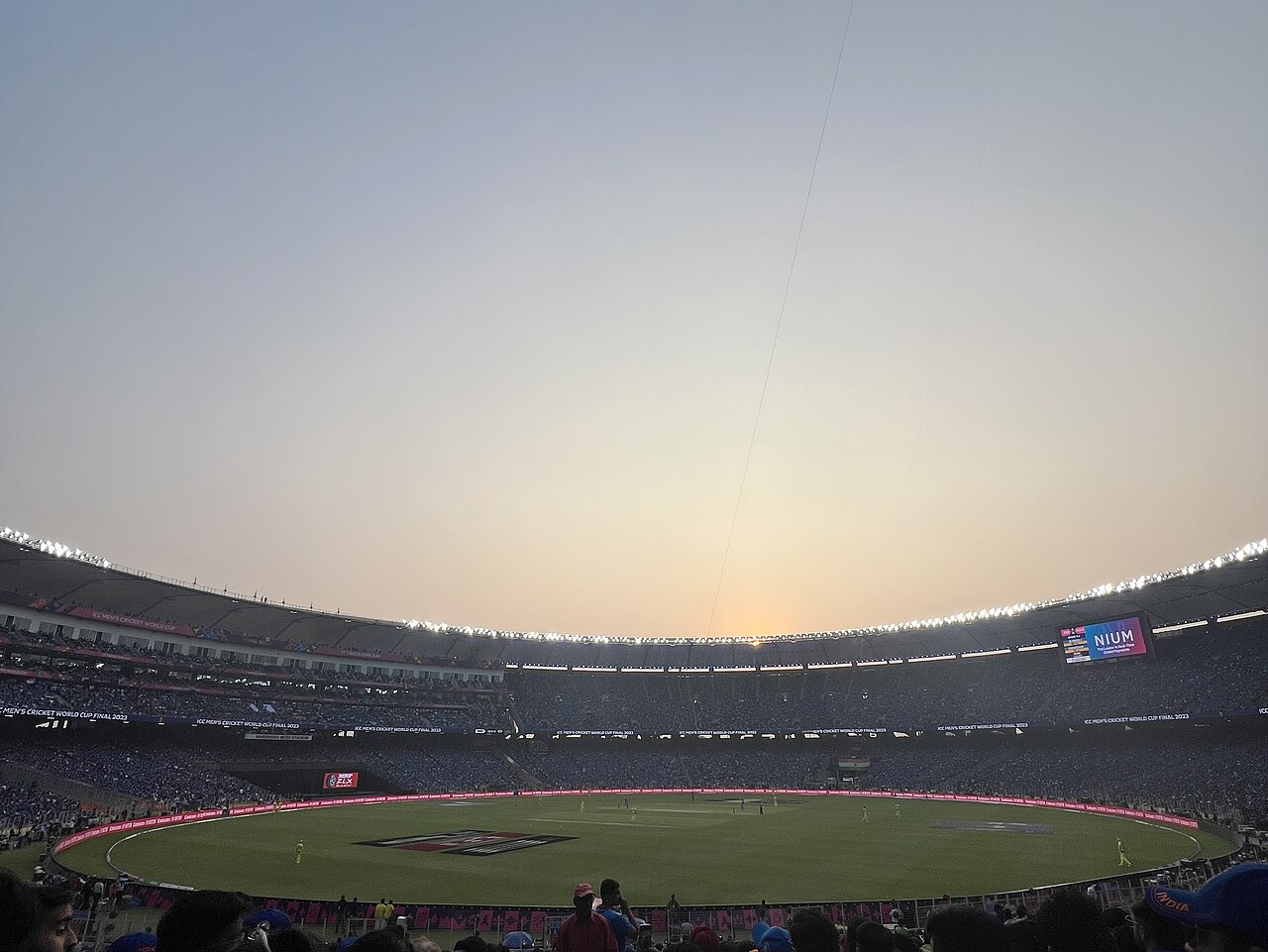
Up the road in Ahmedabad, the Narendra Modi Stadium holds well over a lakh of spectators, which makes it the largest cricket ground in the world by a comfortable margin. Two design decisions matter more than the raw capacity does.
The first is the lighting. Instead of four towers standing at the corners, the roof carries a continuous ring of LEDs, so the long tower shadows that stripe across other grounds during an evening session simply are not there. The second is the square. It holds roughly eleven separate pitch strips, several times what a conventional venue bothers to prepare, and that number quietly changes what the ground is.
Why eleven strips makes venue history a weaker guide
A ground with a handful of pitches tends to behave like itself. The strips age at a similar rate, get similar preparation and similar rolling, and a venue average genuinely describes something. Eleven strips breaks that comfortable assumption, because now somebody chooses which one a particular match is played on.
Two fixtures at the same address a few weeks apart can therefore be played on surfaces that behave nothing like each other, while every statistic ever compiled files them under one venue name. Read the ground's history and you are averaging across a series of deliberate decisions rather than across one settled square. That is a different problem from a pitch that has slowly changed character over a decade, and arguably a harder one, because it can shift from match to match rather than from era to era.
You cannot see any of that from a rooftop in Bhavnagar, and neither can anyone else without being at the ground. The honest conclusion is not that the numbers are useless. It is that they describe an address rather than a surface, and knowing which of those two you are actually looking at is most of the skill.
The two days the whole state looks up
Uttarayan is not background colour here. For two days in mid-January the rooftops of Bhavnagar, Ahmedabad, Surat and Vadodara fill from first light until long after dark, the sky over every neighbourhood turns into a slow-moving argument conducted entirely with string, and the state's attention goes there completely.
Very little in India displaces sport that thoroughly. It is a real feature of the Gujarat calendar rather than a piece of decoration, and along this coast the sea wind makes it better and harder in equal measure. If you follow cricket in this state, mid-January is simply a stretch where nothing else is competing for anyone's attention, and where nobody local schedules anything they mind about.
One account, and the map underneath it
Where an account is permitted to a person at all, it is not a regional product and never has been. It belongs to a person and a phone number rather than to a pin code. The same app, the same ledger, the same verification record and the same support queue appear whether the phone is in Bhavnagar, in Surat, in Kolkata or on a train somewhere between them. Say ₹1,000 moves across from a UPI app: it lands in the same balance, under the same reference number, in the same transaction list, wherever the person tapping approve happens to be sitting.
None of that sameness carries any legal weight, and it would be a serious error to read it as though it did. The product being identical across India is a technical fact about software. What rules reach you is a separate question with a separate answer in every state, and the answer in Gujarat is the restrictive one set out at the top of this page. Two people using the identical screen in two states can be in two entirely different positions. The FairPlay India page is where that variation is written out properly.
The one thing that genuinely does travel with you is language. Gujarati is staffed on live chat and WhatsApp at any hour of the day alongside Hindi and English, and a conversation opened in Gujarati stays in Gujarati rather than sliding back into English after a reply or two. Anyone who has tried to spell a bank record's version of their own name to an agent working in a third language will know why that is worth more than it sounds.
If you have not registered anywhere yet
Then start by re-reading the legal section above, because for a reader in Gujarat that is the part that decides everything else. Establish where you stand before you go looking at a sign-up form, and get that from someone qualified rather than from a page like this one. If your own position does not permit an account, the rest of this section is not for you and no amount of curiosity changes that.
For anyone whose position does permit it, the shape of the process is worth knowing in advance so nothing surprises you halfway through. Registration starts from a phone number and a code sent to it. Identity documents come later, and the check that catches most people out is not the identity check itself but the name match: the name on your identity document has to line up with the name as your bank actually holds it, initials, spellings and all. That single mismatch is what delays most first payouts, and the withdrawal page covers it in the detail it deserves. The FairPlay register page walks through the sign-up itself step by step.
Sort the paperwork before there is any money involved, not afterwards. Documents get verified far more calmly on an ordinary Tuesday than they do when somebody is waiting on a payout and refreshing a screen every ten minutes.
The messages that arrive before you asked for anything
This part deserves a section of its own, because a state with a restrictive position is exactly the environment where people offering shortcuts do well. If a stranger messages you first, on WhatsApp or Telegram or in a comment reply, offering to set up an account for you, hand you a ready-made ID, or arrange something on your behalf, they are not the platform. Nobody official opens that conversation. Support answers you; it does not come looking for you.
An account somebody else created is not your account in any sense that matters. The person who set it up holds the recovery details, the registered number and the ability to lock you out on a whim, and the money sitting in it is only ever nominally yours. The same logic applies to sign-in pages reached through a forwarded link or an advert: a lookalike login screen exists to harvest what you type into it. Reach the FairPlay login from your own bookmark or the official app, every time, and treat any support handle that slid into your messages first as a stranger until it proves otherwise.
Along this coast the tell is usually urgency. A real support agent is happy to wait while you check something; somebody working an angle needs you to act now, before the offer closes, before the match starts, before you think about it. Take the extra ten minutes. Verified channels are listed on the customer support page.
Limits, and the unglamorous paperwork
Deposit caps, loss caps, session reminders and self-exclusion are set out on responsible gaming, and they are worth reading whatever your circumstances and whichever state you are in. Limits set early are painless. Limits set late are an admission, which is precisely why people avoid them.
And if any part of your own position is unclear — which it often is for people who work in one state and keep a family home in another, a pattern this coast knows well — the correct move is advice from somebody qualified rather than an interpretation of a web page. The cricket described above stands perfectly well on its own as sport. Saurashtra winning that first title was worth watching whether or not a single rupee was riding on it, which is roughly the point.